I needed a catch-up brief. I built a control center.
How a catch-up brief for my return from leave became the workbench I would run my work from.
Central reads everything across our tools, works out what needs me, and drafts my next move. It isn't allowed to send a single message on my behalf.
That's my favorite thing about it.
Where it began: "just catch me up"
Step away from a startup and it doesn't wait for you. It sprints. When I started planning my return from maternity leave, my need was simple: one document that would read everything that happened while I was out and tell me what mattered.
Omar, our COO, had written about the second brain he runs with Claude Code. That was the spark. So I opened Claude Code and started building a catch-up brief.
But the moment I started sketching it, the real question was obvious. If this can catch me up once, why can't it help me run my work every day?
So before building anything, I wrote down what I actually needed. Something that tells me what needs me right now. Something that finds the problems nobody raises. Something that fixes things once instead of five times. Something that keeps the reasons behind decisions, helps me show up for my people, and never acts without me.
That list became the spec. The spec became Central.
A workbench, not a report
A catch-up brief is a snapshot. My job is a moving target. And at a company growing this fast, information is never the problem. Workflows change in a Slack thread. Slack says one thing, Asana says another, and Notion was right last month.
Reading all of it was never my job. Deciding is. So Central was never going to be something to read. It had to be something to work in.
A brief can live in a markdown file. A workbench can't.
Getting the data in meant one API per source, every one of them read-only:
| Source | How it connects | What Central reads |
|---|---|---|
| Slack | User token for reading, plus a separate bot token used only for alerts to me | Channels, private channels, DMs, threads |
| Asana | Personal access token | Tasks, comments, projects, assignees, due dates |
| Notion | Integration token | Pages and databases shared with the integration |
| OAuth with read-only scopes | Gmail, Calendar, Drive, Sheets | |
| Periskope | REST API key | Client conversations, tickets, audit logs |
| Fireflies | API key | Meeting transcripts and summaries |
The trick that made it work was giving everything one shape. A Slack message, an Asana comment, a Notion edit and a meeting transcript look nothing alike, so each connector translates what it reads into the same event format: source, author, channel or project, thread, timestamp, text, link and the raw payload. Everything downstream works on that one shape, so adding a source doesn't mean rewriting the rest.
Each source also keeps a saved cursor, so every sync reads only what's new and nothing is ever rescanned from scratch. If Central goes down for a day, the next run picks up exactly where it stopped. And each connector reports its own blind spots. Notion only shows an integration the pages explicitly shared with it, so Central tells me which ones it still can't see.
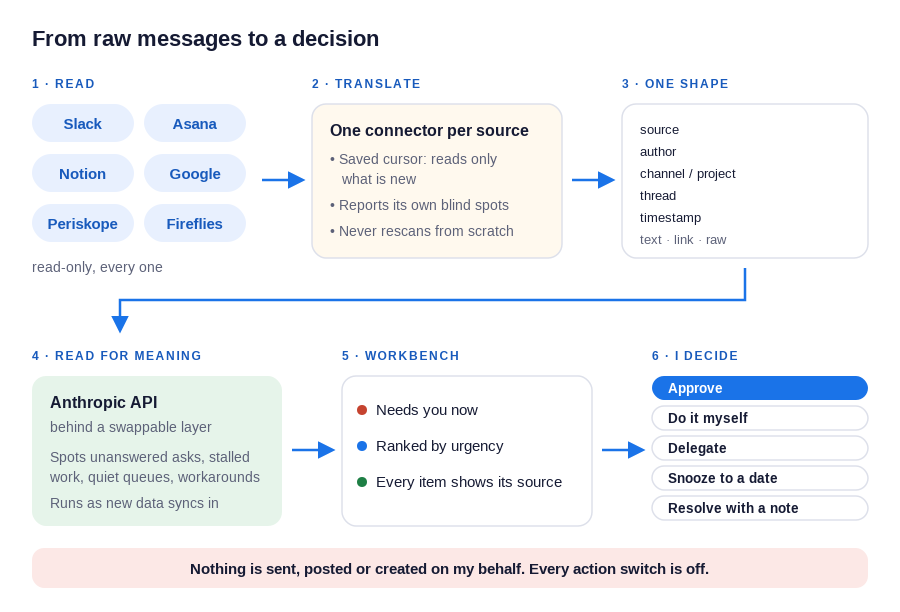
Central reads Slack, Asana, Notion, Gmail, Calendar, Drive, client chats and meeting transcripts, and turns all of it into a workbench: a ranked list where every item can be handled right where it sits. Approve the suggestion. Do it myself. Hand it to someone by name. Snooze it to a date. Resolve it with a note.
Every item shows where it came from and why it ranked where it did. When sources disagree, the most recent one wins and the conflict is flagged.
And nothing sits forever. Every item ends up resolved, delegated, snoozed with a date, or dropped. Delegate something and let it go quiet, and it comes back. Ignore something, and it climbs the list until I can't.
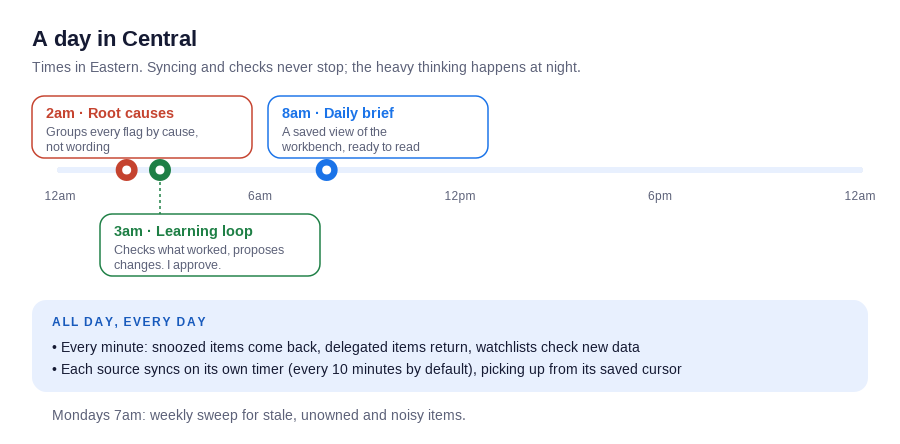
The catch-up brief I started with still exists, alongside a daily brief that's ready at 8am. Both are just saved views of the workbench now, not the main event.
Seeing what nobody says
A workbench is only as good as what lands on it, and the problems that matter most are often the ones nobody raises.
Nobody on a busy team says "I'm blocked." They say "any update?" They say "still waiting on this." Or they say nothing, find a workaround, and move on. Those are the problems that hurt most, because they never reach me.
So Central goes looking. It reads for meaning, not keywords. It notices requests nobody answered, work that stopped moving, teams waiting on other teams, access that keeps breaking, side-channel workarounds, and the strange silence of a person or queue that's usually busy.
That reading for meaning runs through the Anthropic API, behind a provider-agnostic layer so I can swap the model without rewriting anything. And it runs continuously as new data syncs in, not once a day.
Each roadblock arrives as one item: what's blocked, who's affected, how long, what it's waiting on, and a suggested next move. The urgent ones skip the line and land in my Slack DMs, sent by a bot with exactly two scopes: enough to message me, and nothing else.
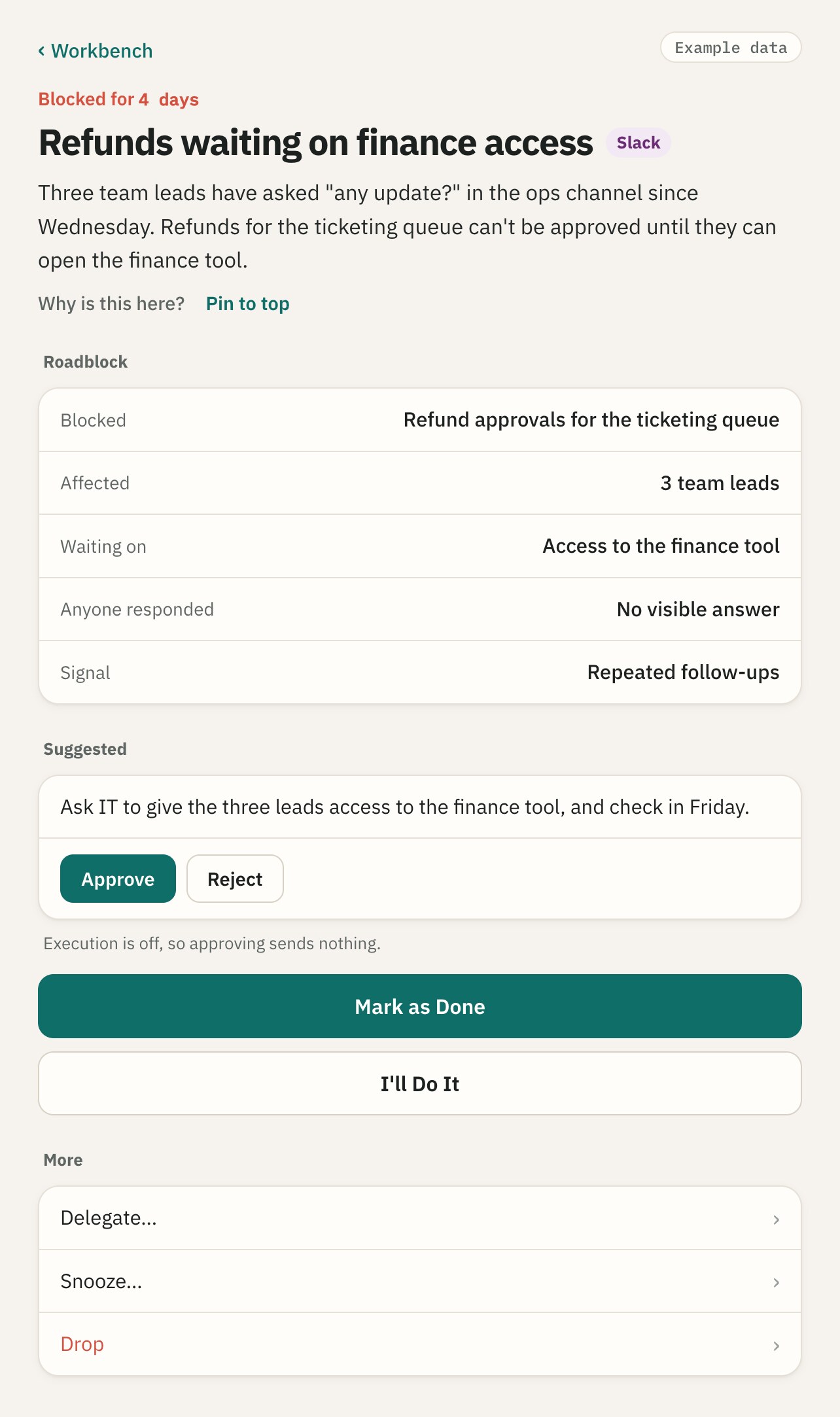
The first version was a little too eager. It flagged everything that sounded like a problem. Now it waits for real signs that something is stuck, and every time I mark something "not a blocker", it gets a bit sharper.
Fixing things once
Catching a problem isn't enough if it keeps coming back.
If I fix the same problem three times, I haven't fixed it. I've just gotten good at patching. Patches are seductive in a fast company. They work today. They make the noise stop. And they hide the real problem until it comes back wearing a different outfit.
So every flag and roadblock gets a guess at its root cause: access, unclear ownership, a process gap, a broken handoff, training, capacity, a vendor. Every night at 2am, a job runs a deeper model over everything and groups it by cause rather than by wording. Two problems that look nothing alike can turn out to be the same problem.
When a pattern builds, Central writes it up as a systemic issue: every instance, whether it's getting better or worse, what's been tried and why it didn't hold, a few long-term options, and a draft project to fix it for real.
"Fixed three times, came back three times" is the most useful sentence it can show me.
Keeping the why
Coming back from leave, I knew the decisions wouldn't be the hard part to catch up on. The reasons would be.
Decisions at a fast company get made in threads, in meetings, in passing. The decision survives. The reasoning usually doesn't. Without it, you can't tell whether something is a choice or a constraint.
So Central keeps a decisions register with four parts: what was decided, why (including the options that lost), the constraint that forced it, and what's still open. That third part is my favorite. It's the difference between "for now" and "forever".
| Part | What it holds |
|---|---|
| What | The decision itself |
| Why | The reasoning, including the options that lost |
| Constraint | What forced it: "for now" or "forever" |
| Open | What's still unresolved |
It's filled from Slack threads, Asana, Notion and Fireflies meeting transcripts. The first run read back through everything since I left. Since then, it updates live.
When people disagreed, both views stay on the record. When something is inferred, it says so.
Showing up for people, not just their work
Work is only half of my job. People are the other half.
I want to walk into a 1:1 knowing where someone is, not just where their tasks are. So Central keeps a private page for each person I work closely with, built from who I actually talk to most and refreshed daily: when we last really talked, what each of us owes the other, what was left open, and their recent wins and concerns. Before a 1:1, it pulls our last meeting notes from Fireflies and puts together a short prep with loops to close and questions worth asking.
This is the part I built most carefully. Every fact has a source. Inferences are marked. Anything wrong gets deleted and never comes back. Health, religion, politics, sexuality and anything said in confidence are never recorded.
The goal is to be a more present leader. Not a more watchful one.
It suggests. I decide.
The most important decision went against the obvious move. Everything about AI tools pushes toward automation: let it send the reply, post the update, create the task. I decided from the start that Central wouldn't.
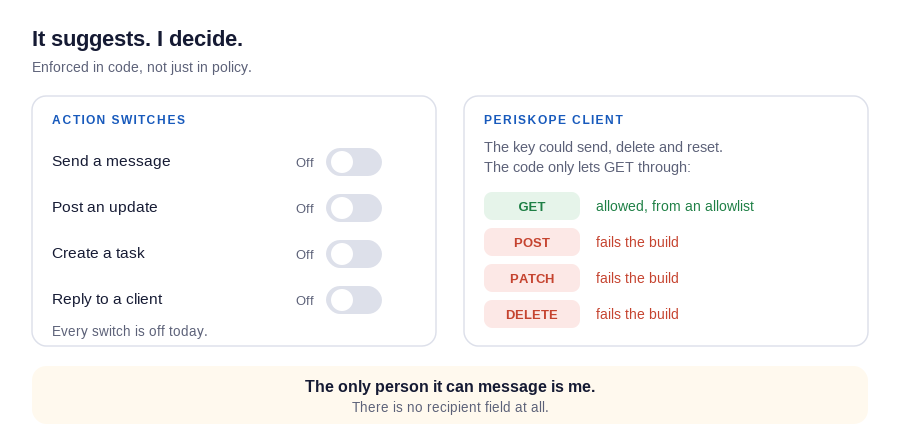
Central can read. It can rank. It can draft. But every connection is read-only, and nothing gets sent, posted or created unless I've switched on that exact kind of action. Right now, every one of those switches is off. We handle clients' travel and their private conversations, so trust had to come before features.
That's enforced in code, not just in policy. Google connects with read-only OAuth scopes. Credentials live in Railway environment variables, and the code only knows their names.
The Periskope key was the interesting one. It can technically send messages, delete chats and reset phones. So the code wraps it in a client that only allows GET requests from an allowlist, and a test fails the build if anyone adds a POST, PATCH or DELETE.
Even webhooks wait. They'd be faster than polling, but subscribing to one is itself a write to someone else's settings. So Central polls until I approve them, and once they're on, every incoming webhook gets verified with a signing secret before Central trusts it.
A few more rules I'm stubborn about:
- The only person it can message is me. The code that sends alerts has exactly one possible recipient. There's no setting to change it, because there's no recipient field at all.
- I send my own messages. When I delegate, it drafts the note and opens my DM with that person. I hit send.
- Show the source, label the guesses. Every item links to where it came from. Tone and root causes are marked as estimates.
- No silent learning. Every night at 3am it checks which suggestions worked and which flags I ignored, then proposes changes with the evidence. Nothing changes until I say yes.
- A blind spot reported beats a gap hidden. If it can't see something, it tells me.
Leaving out the ability to act is what makes it easy to trust. And easy to say yes to.
What I'd tell anyone looking to build their own version
Start from the job, not the tools. It's tempting to organize something like this around Slack, Asana and Notion. It's useful when it's organized around what you actually do all day.
Write the spec like it's the boss. I kept one markdown file with every rule and every decision, dated. Its opening says that if anything conflicts with a guess, the spec wins. Claude Code built from it one checkpoint at a time. That document turned out to be the most valuable thing I made.
Let it be wrong early. Tuning is the work. Every "not useful" I mark makes tomorrow's list better.
In a company that runs on speed, the most useful thing I built is something that slows down just long enough for me to make the call.